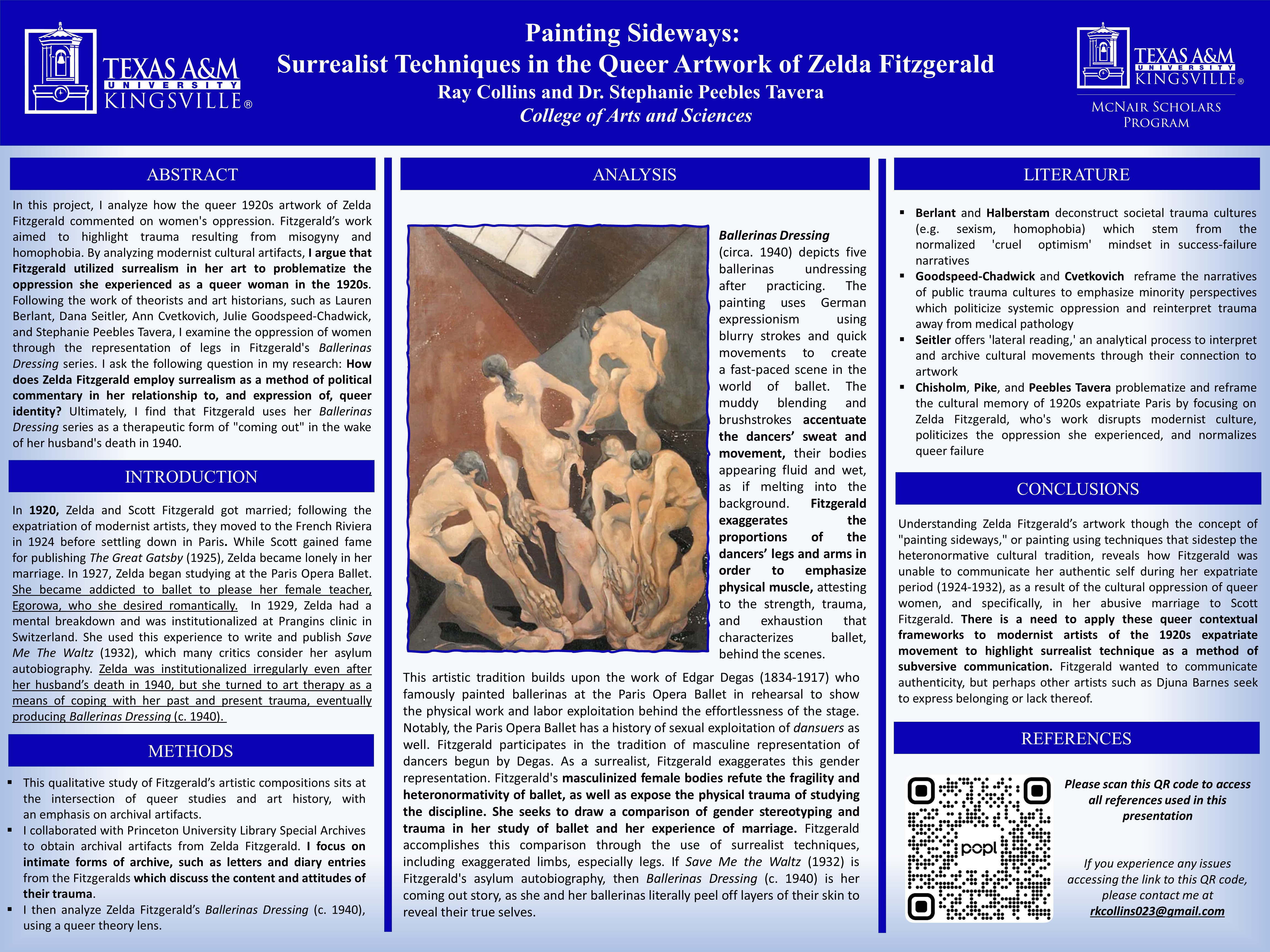
In this project, I analyze 1920s queer modernist women’s fine art—primarily examining Zelda Fitzgerald’s surrealist artwork—and how this expression expands upon contemporary cultural and political narratives of the masculine female body. Fitzgerald’s work, which reflected the societal dismissal and oppression they experienced in their communities, aimed to highlight the traumas they endured as a result of misogyny and homophobia. By analyzing modernist cultural artifacts, I argue that Fitzgerald utilized surrealism in her art to problematize the oppression she experienced as a queer woman in the 1920s. Following the work of theorists and art historians, such as Lauren Berlant, Dana Seitler, Ann Cvetkovich, Julie Goodspeed-Chadwick, and Stephanie Peebles Tavera, I examine the oppression of women through the representation of legs in Fitzgerald's Ballerinas Dressing series. I ask the following question in my research: How does Zelda Fitzgerald employ surrealism as a method of political commentary in her relationship to, and expression of, queer identity? Ultimately, I find that Fitzgerald uses her Ballerinas Dressing series as a therapeutic form of "coming out" in the wake of her husband's death in 1940.
Keywords: High Modernism, Modernism, 1920s Expatriate France / Paris, Zelda Fitzgerald, Queer studies, Women’s studies
Faculty Mentor: Dr.Stephanie Peebles-Tavera
Department of Arts, Communication, and Literature