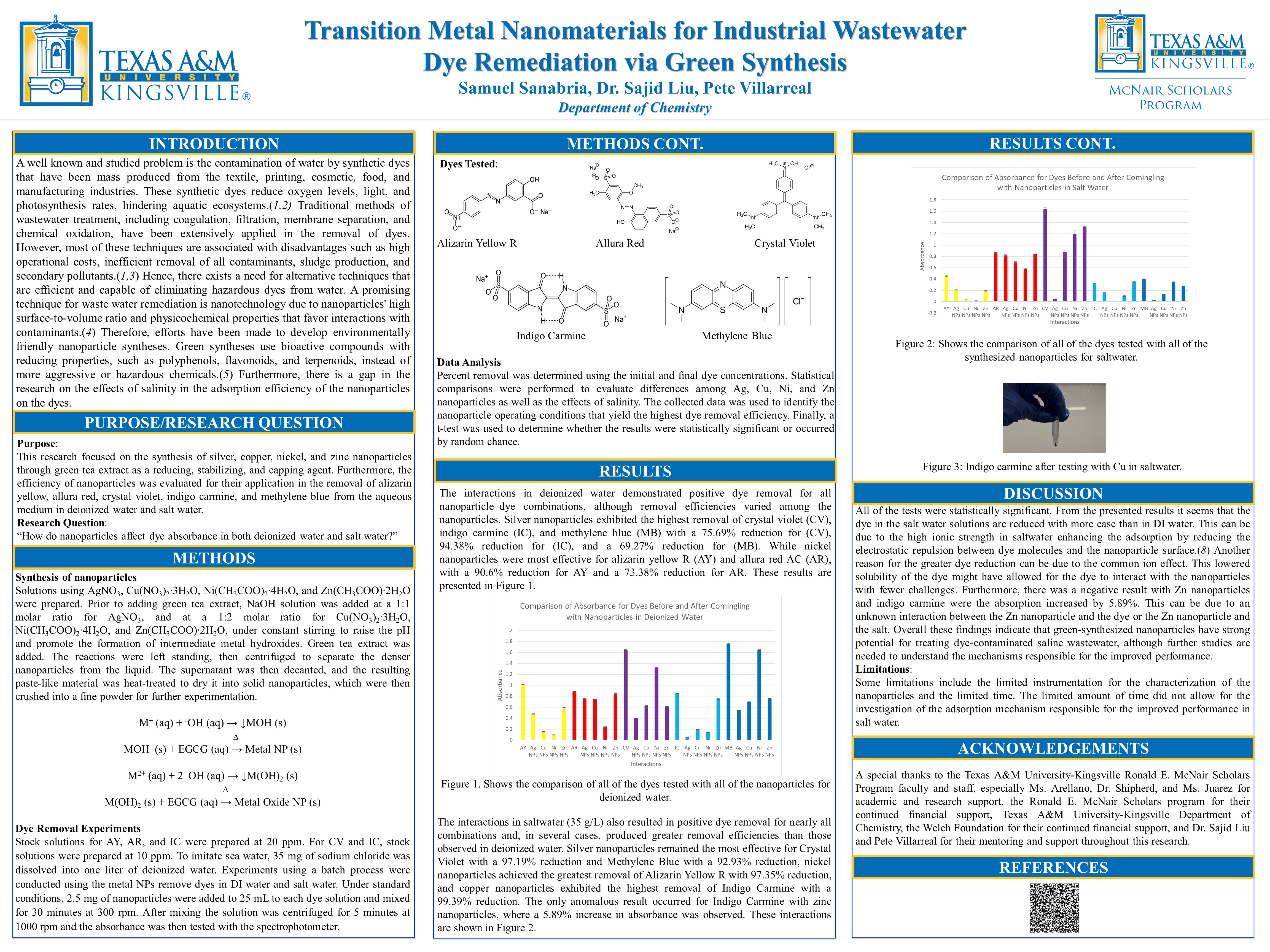
Contamination by synthetic dyes from the textile, printing, cosmetics, food, and manufacturing industries is a major issue for both the environment and human health due to their toxic nature. Many conventional technologies used to treat wastewater are limited by high treatment costs, partial contaminant removal, or the generation of secondary waste. This research focused on the synthesis of silver (Ag), copper (Cu), nickel (Ni), and zinc (Zn) nanoparticles using green tea extract as a reducing, stabilizing agent, and a capping agent, and the evaluation of the efficiency of their application for the removal of alizarin yellow, allura red, crystal violet, indigo carmine, and methylene blue from the aqueous medium. Nanoparticles were synthesized using green chemistry technology and analyzed in batch adsorption tests. Concentrations of the dyes before and after the treatment process were analyzed using UV-Visible spectroscopy, and a paired t-test was conducted to determine the statistical significance of the results. All nanoparticle–dye interactions were statistically significant and demonstrated substantial dye removal in both deionized water and salt water. Silver and nickel nanoparticles exhibited the highest removal efficiencies, with removal efficiencies reaching up to 99.39% removal, and saltwater enhancing dye removal for many nanoparticle–dye combinations. These findings demonstrate the potential of green-synthesized transition metal nanomaterials for wastewater remediation.
Faculty Mentor: Dr. Sajid Lui with assistance from Prof. Pete Villarreal
Department of Mathematics and Physical Sciences