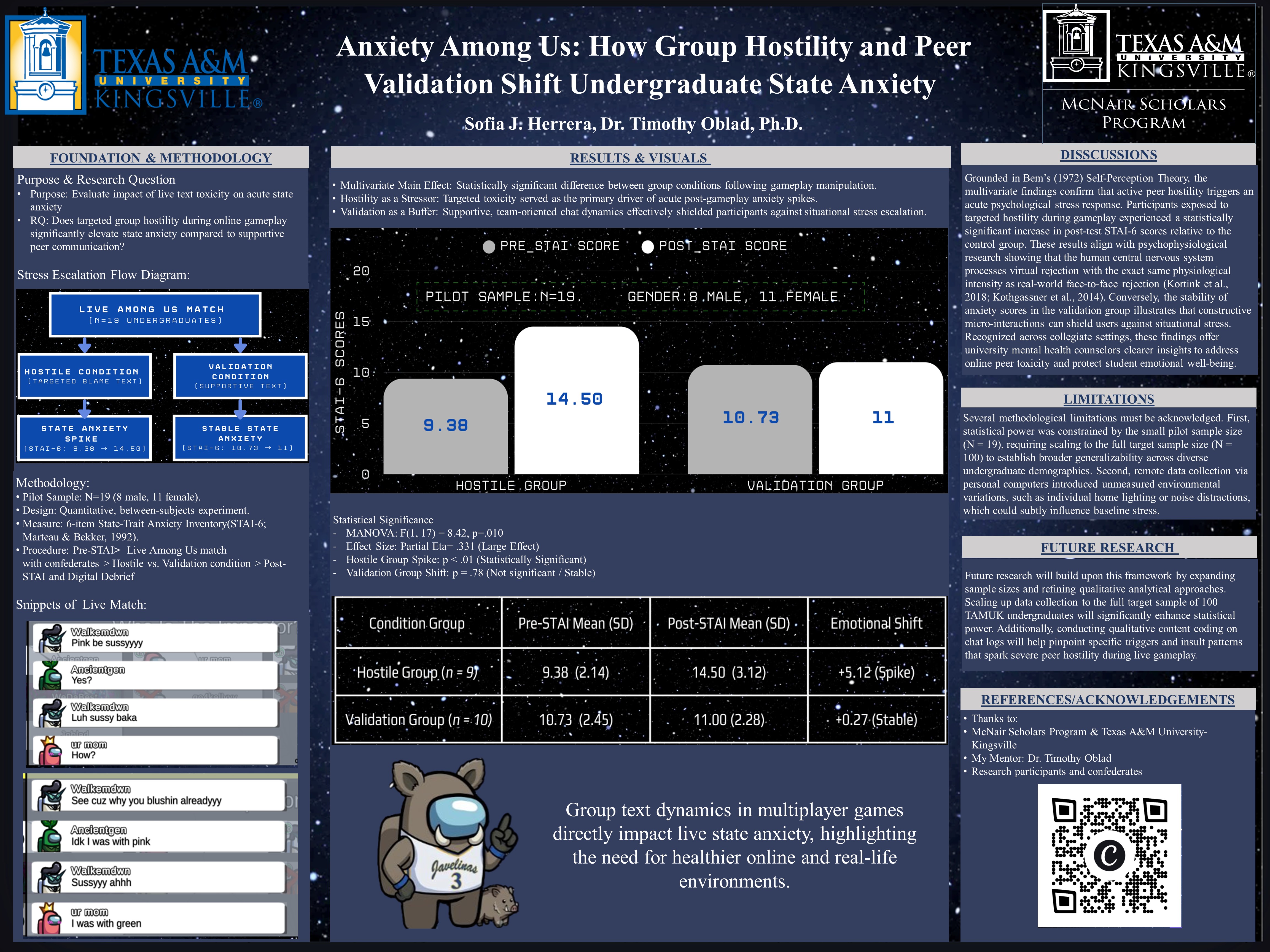
This quantitative experimental study investigates the impact of active peer hostility within live digital text interactions on state anxiety among undergraduate students at Texas A&M University-Kingsville. Grounded in Self-Perception Theory (Bem, 1972), this research examines how collective digital feedback influences situational stress during multiplayer gaming. A pilot sample of 19 undergraduate participants (N = 8 male, N = 11 female) completed a baseline anxiety assessment using the 6-item State-Trait Anxiety Inventory (STAI-6) before entering a controlled gaming session of Among Us with research confederates. Participants were randomly assigned to either a validation condition, receiving neutral team-oriented communication, or a hostile condition, where confederates initiated targeted blame and group hostility. Post-test measures using the 6-item State-Trait Anxiety Inventory (STAI-6) scores were analyzed using a Multivariate Analysis of Variance (MANOVA). Results demonstrated a statistically significant multivariate main effect across conditions. Participants in the hostile condition experienced a significant increase in post-test state anxiety (M = 14.50, SD = 3.12), whereas those in the validation condition maintained stable anxiety levels (M = 11, SD = 2.28). These preliminary findings confirm that live text toxicity operates as an acute social-evaluative threat capable of disrupting emotional security in collegiate populations.
Faculty Mentor: Dr. Timothy Oblad
Department of Social and Behavioral Sciences