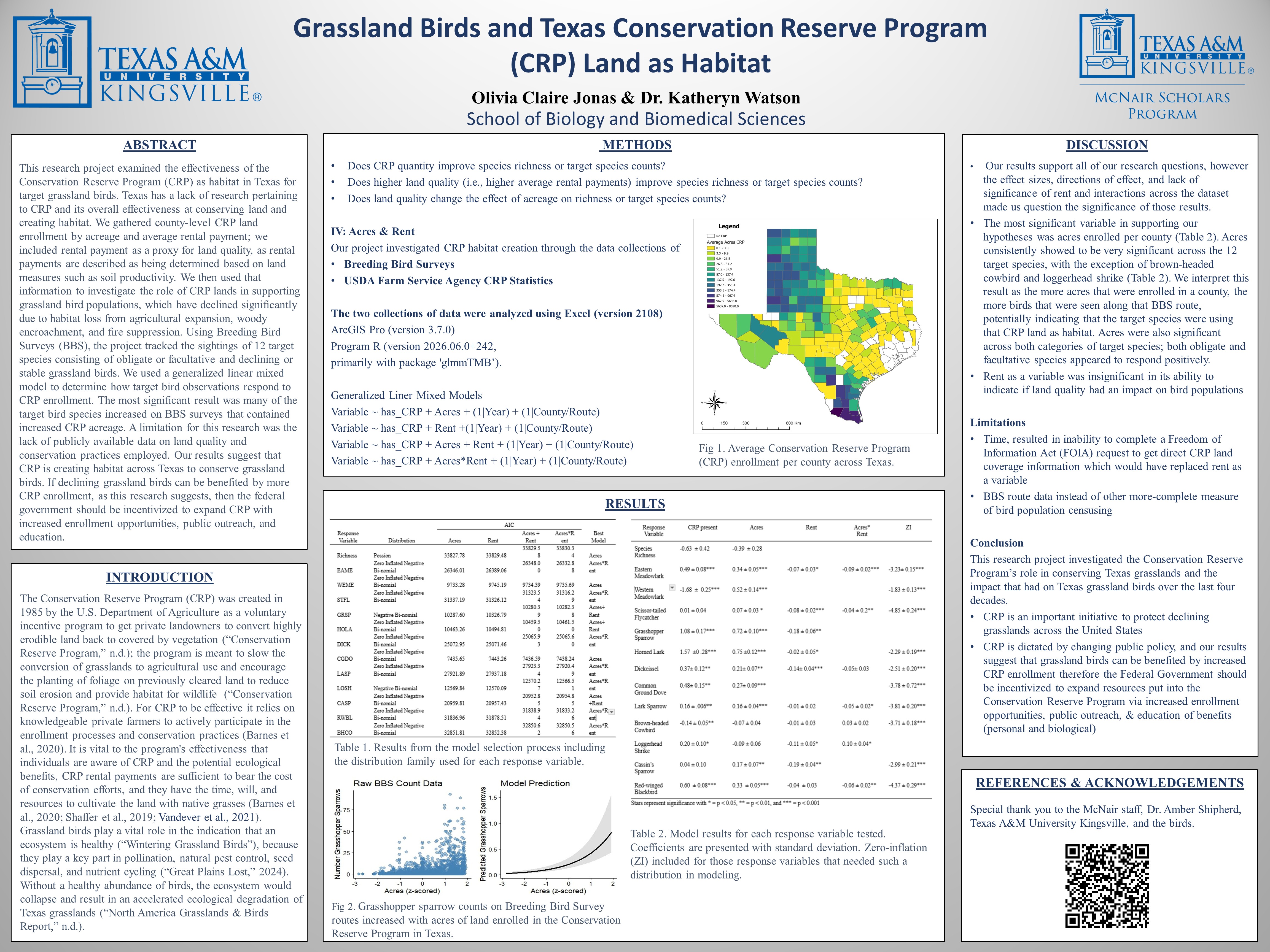
This research project examined the effectiveness of the Conservation Reserve Program (CRP) as habitat in Texas for target grassland birds. Texas has a lack of research pertaining to CRP and its overall effectiveness at conserving land and creating habitat. We gathered county-level CRP land enrollment by acreage and average rental payment; we included rental payment as a proxy for land quality, as rental payments are described as being determined based on land measures such as soil productivity. We then used that information to investigate the role of CRP lands in supporting grassland bird populations, which have declined significantly due to habitat loss from agricultural expansion, woody encroachment, and fire suppression. Using Breeding Bird Surveys (BBS), the project tracked the sightings of 12 target species consisting of obligate or facultative and declining or stable grassland birds. We used a generalized linear mixed model to determine how target bird observations responded to CRP enrollment. The most significant result was that many of the target bird species increased on BBS surveys that contained increased CRP acreage. A limitation for this research was the lack of publicly available data on land quality and conservation practices employed. Our results suggest that CRP is creating habitat across Texas to conserve grassland birds. If declining grassland birds can be benefited by more CRP enrollment, as this research suggests, then the federal government should be incentivized to expand CRP with increased enrollment opportunities, public outreach, and education.
Faculty Mentor: Dr. Katheryn Watson
Department of Biology and Biomedical Sciences